Double Indemnity and the Lost Art of Noir Fiction

Noir fiction is a lost art, and maybe for good reason. The genre is rife with misogyny, sexism, and toxic masculinity, traits that don’t fare well in modern culture. But every era is just a capsule that shows how its people were raised, what they valued, and what they envisioned for the future. While we can read noir fiction with a bad taste in our mouths, we can also read it with detached curiosity about the time capsule in which it’s contained. In doing so, we inevitably find a genre rich with sharp storytelling, witty dialogue, and crafty characters.

Double Indemnity

The novel Double Indemnity is no exception. Written in 1943 by American novelist James M. Cain, it inverts the typical salty and wise-cracking detective story into one of an anti-hero. This is the story of the criminal himself, insurance salesman Walter Huff.

Huff is hardworking, all-American, laser-focused, and keen to ferret out shady deals to protect the firm he works for. When he drops by the Nirdlinger residence to remind the elusive Mr. Nirdlinger to renew his automobile insurance policy, he meets the volumptuous femme fatale Phyllis, the dissatisfied wife of Mr. Nirdlinger. Phyllis discusses insurance with Huff, feigning ignorance of the whole process, but when she starts fishing for information about accident coverage, Huff grows suspicious. He knows immediately that Phyllis wants accident insurance to pull a fast one on Mr. Nirdlinger, and he wants no part of it. That is, until later that night when he starts stewing over the idea. What if he devised a perfect scheme to collect an accident insurance claim? After all, Huff knows every angle of the insurance business, and it’s something he’s thought about more than once. 

Romance, premeditated murder, and a faked train accident

Thus begins a taut narrative of romance, premeditated murder, a faked train accident, and a suspicious insurance agency that will find any reason not to pay out the claim. Huff plays it cool, but as his boss, Keyes, begins to piece together the evidence, the tension begins to crack the relationship between Huff and Phyllis. Huff drifts away out of self-preservation, but he begins to form a close bond with Nirdlinger’s daughter from a previous marriage, who confesses that she thinks her stepmother, Phyllis, killed her father. Huff tries to talk her down, until he learns a shocking truth about Phyllis, one that will lead him to do the unthinkable.

While readers might be quick to dub Phyllis an archetypal spider-woman, who lures Huff into the twisted web of her plot, it is Huff who masterminds the murder and orchestrates it. Still, it’s difficult to see Walter Huff as a real criminal. Cain sketches his character with enough human complexity that he emerges as a near hero by the end of the book, leaving Phyllis behind as the twisted villain. But we can’t quite forgive Huff for committing murder, and neither can Cain. In the end, Huff’s and Phyllis’s mutual culpability drags them to a surprising ending.

Say what you will about the noir fiction genre of the early 20th century, but many of these stories were ahead of their time. Their exploration of sexuality and hard crime were deemed appalling by readers of the era, though these themes feel tame by modern standards. Still, the grip these stories have on the history of crime fiction and thrillers is undeniable, and they provide a history lesson that will keep you up reading late into the night. 


Guest Post courtesy of Ryan Doskocil

Literary Event: Lunch Doodles with Mo Willems

The Kennedy Center Artist-In-Residence, Mo Willems, welcomes readers, writers, artists, and creative people everywhere to join him for Lunch Doodles. This fun series is being hosted online by The Kennedy Center daily at 1:00 pm Eastern Time. In these sessions, Willems uses his doodles to teach artists of all levels how to get creative with written and visual art. Each day, Willems is providing new inspiration and fun ideas to keep our creative sides busy while we keep our bodies healthy.

Don’t worry if you can’t be there for the 1:00 pm live stream, each session is recorded and can be found on The Kennedy Center website or on YouTube for free streaming! Go join Willems on his journey to spread the joy of art in its simplest form: doodling.

For more information about this series, click here.


Location: Hosted Online by The Kennedy Center 

Time: 1:00 pm ET *Sessions are recorded and can be found for free on The Kennedy Center website or YouTube

Book Review

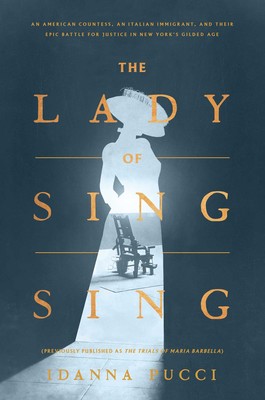
The Lady of Sing Sing by Idanna Pucci

Genre: Historical Biography
Pages: 304
Format: Hardcover
Buy Local 
My Rating: 4/5 Stars

Summary

The Lady of Sing Sing is a poignant retelling of the first woman in America sentenced to the death penalty and the women worldwide who came to her aid. In 1895, Maria was accused of killing a man who seduced and falsely promised to marry her. Her case lit New York City on fire, even attracting the attention of an American Countess in Italy, Cora Slocomb.

Cora works tirelessly on Maria’s case, seeing her as another poor Italian immigrant being treated unfairly by the American courts. Idanna Pucci, Cora’s great-granddaughter, expertly weaves together the struggles of immigrants, capital punishment, prejudice, violence against women, women’s autonomy, and the power struggles between those in power and women and ethnic minorities. She blends intimate characterizations with broader political machinations to tell a nuanced story of the trials of Maria Barbella.

Thoughts

What I most enjoyed about this book is how the author seamlessly blended fiction with history. It is impeccably researched, yet extremely engaging. As most students of history like myself can attest, that balance is incredibly difficult to achieve and many history texts end up bland and dense. These two characteristics are the opposite of The Lady of Sing Sing, which draws the reader in from the first chapter. I loved the intimate view of the historical figures and how well Pucci captured what their inner lives might be like during such difficult times.

The content of this book is also increasingly relevant today. The death penalty is still unfairly and disproportionately inflicted on minorities, and America is still obsessed with capital punishment. It is easier to reflect on these aspects of American culture when looking at them through the lens of the past. This book offers the chance for that reflection because of its personal characterization of the struggles and unfairness associated with the death penalty. I was shocked as I read about the ineptitude of Maria’s first trial and how the judge’s racist attitudes influenced his decisions, but I was filled with hope by the thousands of people who tried to help Maria. These ideas are not as foreign as they seem and it is interesting to see how the historical legacy of ideas on the death penalty have translated into our modern perspectives. 

Overall, it was a good read and I definitely recommend it to anyone who is interested in history, social justice, or who just wants to read something engaging and different. Also, don’t forget to read the Afterword!


Thank you to Changing Hands Bookstore for providing an ARC
in exchange for this honest and unbiased review.

Book Review

The Selection by Kiera Cass

Publisher:  HarperTeen
Genre: YA Fiction
Pages: 352
Format: Paperback
Buy Local 
My Rating: 3/5 stars

Summary

In a dystopian world, the United States has become a monarchy named Illea where citizens are forced into a One (royalty) through Eight (criminals and outcasts) caste system. The prince of the country is looking for a new wife and will hold a competition with ordinary girls from all different castes and locations around the country to choose his new princess. 

 Kiera Cass’s novel, The Selection, is another classic 2010’s dystopian piece similar to Divergent, Hunger Games, with even a little bit of “The Bachelor” mixed in. The main protagonist in the story is a fiery red-head named America, a Five, who does not want to follow the rules of this repressive government. She is already in love with Aspen, a Seven, but when she is selected to enter into the Selection (basically the Prince’s version of “The Bachelor”), she is forced to leave behind her old life and enter into this cutthroat competition against girls of all different castes and locations for the crown.

Throughout the book, America comes to learn more about herself and what she is capable of and questions the beliefs and prejudices she has held for her whole life.

Thoughts

The Selection in its plot is very ordinary, almost fulfilling that checklist of YA dystopian novels: the love triangle, the feisty main character who has a blatant disregard for the rules, and the clear mistrust between the protagonist and the main leadership character (in this case, America and the King Clarkson). Despite its seemingly “normal-ness,” the book actually always sticks with me. Why? It’s not only because I have a taste for these dystopian YA novels, but because the book used such descriptive language so that I could see each character, emotion, and location clearly in my head. The images and feelings that were described by America and her backstories to help the audience understand the context of the situation are so detailed that I could imagine each of the scenes in my head, play-by-play. I knew exactly how the palace looked, her feelings about the Prince, the Selection, and even the strawberry tart she had before her first official meeting with Prince Maxon. The imagery in the text was strong and will make it memorable in this way for the audience. 

One of the most interesting themes of the story was actually along the lines of judgement and prejudice. Throughout the book, each of the characters has some sort of a judgment about the other characters due to the stereotypes of the castes and royalty that they have learned growing up. This stubborn prejudice clouds America’s judgement and prevents her from seeing the important and caring qualities that Maxon has, and her innate quality to rule. Maxon, on the other hand, also had prejudices about those from lower castes but he was quick to learn from his mistakes, which shows a stark contrast between America and Maxon’s characters and learning curves.

Overall, although the book was a bit predictable and followed the classic YA fiction tropes, I still found that it combined interesting themes and borrowed from pop culture in ways that were new (such as using the concept behind The Bachelor). It was the perfect before-bed read—relaxing, interesting, with the perfect amount of romance mixed in.


Thanks to Israa Jahan for this guest post.

Literary Event: Save With Stories Online Readings

It’s likely that your daily life has been affected by the spread of COVID-19 in the United States. News sources and social media are constantly being inundated with updates on cases, school closures, and panic buying. Amidst the chaos, it’s important to help one another in these tremulous times.

While everyone’s lives are being affected by this pandemic, some suffer more than others. Across the U.S., millions of children depend on schools to provide them not only to learn, but also to eat. In light of nationwide school closures, Jennifer Garner and Amy Adams have teamed up with Save the Children and No Kid Hungry to create #savewithstories. Celebrities across the nation are reading children’s stories through Instagram and Facebook, as well as collecting donations to ensure that school and community programs are well-equipped to keep kids fed and learning.

For more information about this program, and to donate, click here, and be sure to follow this initiative on Instagram at @savewithstories.