
Book Review

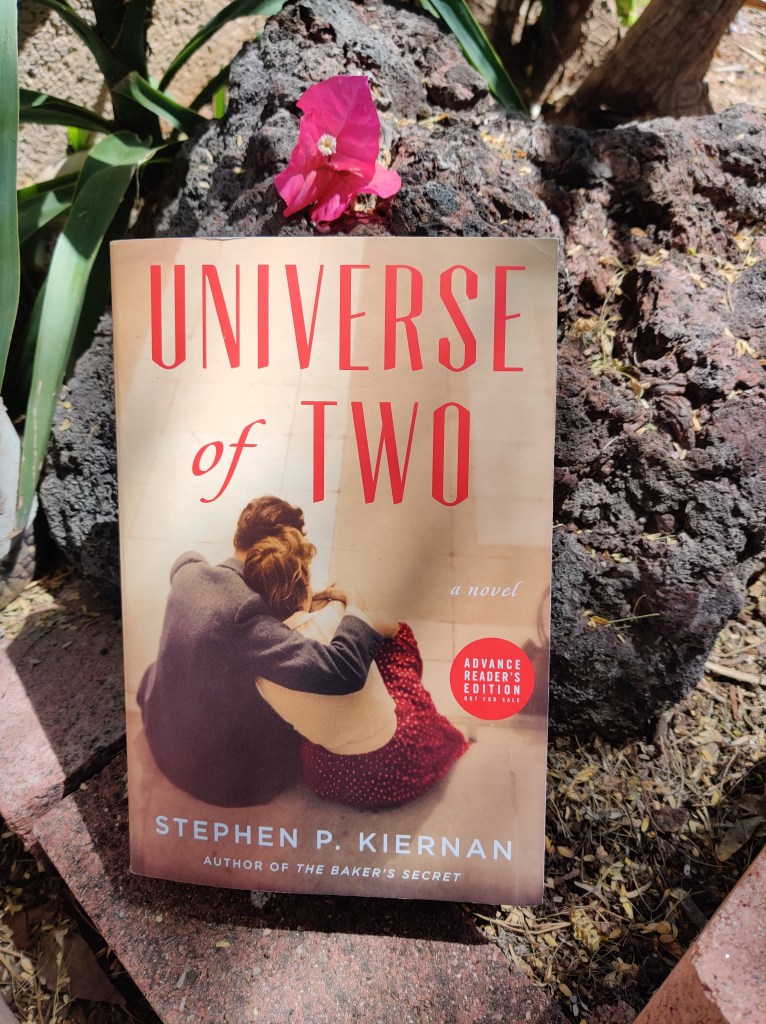
Universe of Two by Stephen P. Kiernan

Publisher: HarperCollins 
Genre: Historical Fiction 
Pages: 429 
Format: Paperback 
Buy Local
Rating: 4/5 Stars
Summary

Stephen P. Kiernan’s Universe of Two is a time machine back to the year 1943. The story takes place in the United States as the country is at war with the allied forces in World War II. Unlike many World War II novels, Universe of Two doesn’t follow the story of a soldier or officer fighting in the war. Instead, it focuses on the connection between two civilians who play just as significant a part in the war efforts as any man in battle.

Brenda Dubie is a spoiled nineteen-year-old girl who spends her time working at her family’s music shop and dating every soldier she can find who is home on leave. Her life changes when she meets a young mathematician named Charlie Fish who is at work doing calculations for the US government. As the pair build a romantic connection, Charlie is pulled deeper into the war efforts, eventually finding himself in New Mexico working as a vital piece of the Manhattan Project. His role in the project to create the atomic bomb riddles Charlie with guilt. Brenda, who pushes him so hard to pursue his work, shares the heavy moral burden Charlie faces when she finally realizes the consequences of his work. The pair are faced with the difficult task of trying to love each other while making up for the horrible destruction they helped to create.

Thoughts

What impressed me most about Universe of Two was the way it didn’t try to romanticize either war or love. Although it is a historical romance, the novel was utterly realistic about the moral challenges faced by its characters. The chapters alternate between Brenda’s narration and a omniscient narrator reporting on Charlie’s top-secret work. As a reader, I felt a deep frustration at how naïve Brenda was to the severity of Charlie’s situation. Kiernan was able to play with my emotions, drawing me into the story as if it were a train wreck that I could not look away from. Universe of Two is anything but the stereotypical romance novel—it is an honest look at the ways a relationship can be tested and morals overlooked in pursuit of victory. I would recommend Kiernan’s novel to anyone who relishes in the feeling of a bittersweet ending.


Thank you to Changing Hands Bookstore for providing an ARC
in exchange for this honest and unbiased review.

Book Review

Florence Adler Swims Forever by Rachel Beanland

Publisher: Simon and Schuster
Genre: Fiction
Pages: 320
Format: Hardcover
Buy Local
My Rating: 4.5/5 stars

Summary

This novel follows three generations of an American-Jewish family in 1934 Atlantic City. Florence, the youngest daughter, is intent on swimming the English Channel but tragically drowns while training. Her mother, Esther, decides to hide her death to help protect her other daughter’s dangerous pregnancy. Their situation is complicated even further when Joseph, the father, helps a young Jewish woman emigrate from Germany for seemingly no reason. 

The web of secrets ultimately untangles, in the process both harming and freeing members of the family. Florence Adler Swims Forever provides a nuanced account of a family broken on many levels trying to endure, despite the racism, the effects of the Great Depression and the looming threat of Nazi Germany. 

Thoughts

There is no one who loves family secrets and dysfunction more than I do, and this book definitely delivers! It takes a softer approach than these types of books normally do, though. It was wonderfully intimate and heart-breaking, since we got to hear how Florence’s death impacted each member of the family. It was also very well written and was so enthralling that it kept me up well after 2:00 a.m. to finish it. Their lives are messy and the way their stories tangle together kept me wanting more.

It was fascinating to read about how the American-Jewish were reacting to Nazi Germany, as well. Normally, historical fiction set during WWII takes place in Europe, much closer to the action. Reading about the Nazi’s rise to power from a distance both minimizes the threat as well as making it more relatable to the audience, since that is how those of us today learn about the Holocaust. In a world still facing many of the same issues, seeing how such a large threat can seem somewhat small from far away—as well as the true scale of the threat from the perspective of a German Jewish woman—helps contextualize the issue and can help us better understand similar issues that still affect us. 

My only critique is that I wish we had gotten to hear more from some of the characters’ perspectives, because the point of view switched so frequently. Thus, some of the storylines were not as complete as they could have been. The storyline that left me wanting more was how Esther and Joseph’s tense relationship unraveled and came back together. 

Overall, though, this book is definitely worth the read and I recommend this book to lovers of fiction and family secrets. It will keep you reading until the last page!


Thank you to Changing Hands Bookstore for providing an ARC
in exchange for this honest and unbiased review.

Book Review

Unabrow: Misadventures of a Late Bloomer

Publisher: The Penguin Group 
Genre: Nonfiction, Memoir
Pages: 249 
Format: Paperback
Buy Local 
My Rating: 4/5 Stars

Summary

What do aggressive facial hair, childbirth, an unhealthy obsession with the year 1993, and troll dolls have in common? Una Lamarche. Unabrow: Misadventures of a Late Bloomer is a hilarious collection of diary entries, observations, and convoluted graphics, some of which involve the correct way to use a public restroom.

Lamarche’s memoir tackles the most cringeworthy challenges of growing up female. Leapfrogging from one side splitting topic to another, and in no particular order, she takes the reader on a ride through the pitfalls of childhood, puberty, and even adulthood.

Lamarche recalls, with appalling and humorous clarity, her first-time experiences with drinking, sex, jobs-from-hell, and learning how to drive. As the book cover indicates this is “the book June Cleaver would have written if she had spent more time drinking and less time vacuuming.”

Thoughts

I am not sure which I did more of while reading Unabrow: laugh out loud or grimace. Anyone who has ever endured childhood, high school, or parenting will appreciate all the cringey and hilarious moments of this memoir. Lamarche is unapologetic, honest, and brash which makes for some entertaining stories.

Who wouldn’t identify with her obsession with the show Friends and the proclamation that she is the “Chandler” of her roommates? Or an apartment cleaning routine to the Led Zeppelin tune “Stairway to Heaven?” Then of course, there is the titular situation where Lamarche discusses her eyebrows, which, from birth, had joined to form a furry, face caterpillar. Her facial hair pact with her sister is one of those why-didn’t-I-think-of-that moments, and deserving of being the introduction to the book.

Despite my being slightly older than the millennial Lamarche, her stories are ones that any girl who’s ever memorized lyrics to an entire album, or has been dumped by their sixth grade friends can relate to. The random and chaotic format of the book just adds to its charm, and it was as if I was taking a peek inside Lamarche’s brain. As as a result there were some things, like the restroom graphics, that I can never unsee or forget!

Book Review

The Cheapest Nights: A Collection of Short Stories by Yusuf Idris, Translated by Wadida Wassef

Publisher: Penguin Classics
Genre: Short stories, satire
Pages: 181
Format: Paperback
Buy Local (Preorder)
My Rating: 4/5 stars


Published in Egypt in 1954, this collection of short stories captures glimpses of the lives of the Egyptian lower class, most of them based in Cairo. This compilation, which is to be published on June 9, includes a few stories from Idris’s other collections as well. Here, I’ve shared my thoughts on the three stories I found the most remarkable.

Summaries

The Dregs of the City —It all begins when Judge Abdallah loses his wristwatch. Being a textbook introvert and a man of routine, this minor inconvenience sends him into an introspective spiral where he contemplates his social awkwardness and general lack of success with women. But, he must find a wife before he is thirty-five (few aspects of his life are left unscheduled), so he doesn’t give up.

The narrative describes Abdallah’s misadventures with women in a jesting, almost O Henry-esque tone until it takes a sudden turn and we meet the dark side of the man that polite society knows as Judge Abdallah—a morally bankrupt person with no shortage of enthusiasm in judging others for faults in character, especially women. The story depicts in unapologetic detail the carnal urge to abuse one’s power that lurks in the best of us, and the pain of living with oneself after it’s been done.


Did You Have to Turn on the Light, Li-Li? —A priest forgets to end the morning prayer and leaves rows of men bowed in prostration for a long time. This is eventually written off as a joke and added to the annals of the neighborhood. But the narrative reveals the real reason behind the Imam’s lapse.

It goes back to when a young Sheikh Abdel Al is appointed as the Imam of the mosque in Al Batiniyya, where the people are generally intoxicated on opium and hashish throughout the day and go to bed at dawn, when he calls for prayer. But his real test appears in the form of temptation: a woman. When we covet something that we have no right to, we tend to blame ourselves less than we blame the thing itself. The story stealthily underlines that.

Having remained chaste and above impulses all his life, he sees her as the devil incarnate, even as he is drawn to her. Suddenly, he is very aware of his mortal flesh with all its weaknesses. He prays for divine intervention so that he may remain worthy of his position. His deliverance comes in a wave of poetic irony.


The Errand —In his youth, El Shabrawi traversed the length and breadth of Cairo as a city cop. But in recent years, he has been stationed out of town and he would give his life—his words—to go back to the city, if only for an hour. As luck would have it, a woman of unstable mental disposition is brought into the police station one day by her relatives and the need arises for a chaperone to take her to the asylum in Cairo. Predictably, El Shabrawi volunteers and, as no one else does, is given the responsibility of Zebeida.

But, it turns out that it is a little difficult to enjoy all the city has to offer with a woman in tow who is screaming and struggling to get away at every step. El Shabrawi is pushed to his limits as his patience is tested and as he dashes from one government building to another, caught in a web of bureaucracy. His release comes in an unexpected way. When it does, he is taken aback by his own feelings and subsequent actions. It is a story of human compassion written at a time when the subject of mental illness was treated with little sensitivity.


Thoughts

A writer who lived in a time and society of strict moral codes, Idris’s writing is bold yet eloquent. He doesn’t hold back in his dressing-down of the entitled, privileged man, or the underprivileged man, for that matter, and shines a clear light on the oppression of the women they lord over. His stories signify that he acknowledged and despised the hypocrisy of a society that held different standards, always, for men and women, for the powerful and the subjugated.


Thank you to Changing Hands Bookstore for providing an ARC
in exchange for this honest and unbiased review.
Book Review

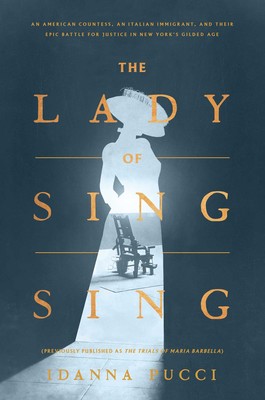
The Lady of Sing Sing by Idanna Pucci

Genre: Historical Biography
Pages: 304
Format: Hardcover
Buy Local 
My Rating: 4/5 Stars

Summary

The Lady of Sing Sing is a poignant retelling of the first woman in America sentenced to the death penalty and the women worldwide who came to her aid. In 1895, Maria was accused of killing a man who seduced and falsely promised to marry her. Her case lit New York City on fire, even attracting the attention of an American Countess in Italy, Cora Slocomb.

Cora works tirelessly on Maria’s case, seeing her as another poor Italian immigrant being treated unfairly by the American courts. Idanna Pucci, Cora’s great-granddaughter, expertly weaves together the struggles of immigrants, capital punishment, prejudice, violence against women, women’s autonomy, and the power struggles between those in power and women and ethnic minorities. She blends intimate characterizations with broader political machinations to tell a nuanced story of the trials of Maria Barbella.

Thoughts

What I most enjoyed about this book is how the author seamlessly blended fiction with history. It is impeccably researched, yet extremely engaging. As most students of history like myself can attest, that balance is incredibly difficult to achieve and many history texts end up bland and dense. These two characteristics are the opposite of The Lady of Sing Sing, which draws the reader in from the first chapter. I loved the intimate view of the historical figures and how well Pucci captured what their inner lives might be like during such difficult times.

The content of this book is also increasingly relevant today. The death penalty is still unfairly and disproportionately inflicted on minorities, and America is still obsessed with capital punishment. It is easier to reflect on these aspects of American culture when looking at them through the lens of the past. This book offers the chance for that reflection because of its personal characterization of the struggles and unfairness associated with the death penalty. I was shocked as I read about the ineptitude of Maria’s first trial and how the judge’s racist attitudes influenced his decisions, but I was filled with hope by the thousands of people who tried to help Maria. These ideas are not as foreign as they seem and it is interesting to see how the historical legacy of ideas on the death penalty have translated into our modern perspectives. 

Overall, it was a good read and I definitely recommend it to anyone who is interested in history, social justice, or who just wants to read something engaging and different. Also, don’t forget to read the Afterword!


Thank you to Changing Hands Bookstore for providing an ARC
in exchange for this honest and unbiased review.

Book Review

The Selection by Kiera Cass

Publisher:  HarperTeen
Genre: YA Fiction
Pages: 352
Format: Paperback
Buy Local 
My Rating: 3/5 stars

Summary

In a dystopian world, the United States has become a monarchy named Illea where citizens are forced into a One (royalty) through Eight (criminals and outcasts) caste system. The prince of the country is looking for a new wife and will hold a competition with ordinary girls from all different castes and locations around the country to choose his new princess. 

 Kiera Cass’s novel, The Selection, is another classic 2010’s dystopian piece similar to Divergent, Hunger Games, with even a little bit of “The Bachelor” mixed in. The main protagonist in the story is a fiery red-head named America, a Five, who does not want to follow the rules of this repressive government. She is already in love with Aspen, a Seven, but when she is selected to enter into the Selection (basically the Prince’s version of “The Bachelor”), she is forced to leave behind her old life and enter into this cutthroat competition against girls of all different castes and locations for the crown.

Throughout the book, America comes to learn more about herself and what she is capable of and questions the beliefs and prejudices she has held for her whole life.

Thoughts

The Selection in its plot is very ordinary, almost fulfilling that checklist of YA dystopian novels: the love triangle, the feisty main character who has a blatant disregard for the rules, and the clear mistrust between the protagonist and the main leadership character (in this case, America and the King Clarkson). Despite its seemingly “normal-ness,” the book actually always sticks with me. Why? It’s not only because I have a taste for these dystopian YA novels, but because the book used such descriptive language so that I could see each character, emotion, and location clearly in my head. The images and feelings that were described by America and her backstories to help the audience understand the context of the situation are so detailed that I could imagine each of the scenes in my head, play-by-play. I knew exactly how the palace looked, her feelings about the Prince, the Selection, and even the strawberry tart she had before her first official meeting with Prince Maxon. The imagery in the text was strong and will make it memorable in this way for the audience. 

One of the most interesting themes of the story was actually along the lines of judgement and prejudice. Throughout the book, each of the characters has some sort of a judgment about the other characters due to the stereotypes of the castes and royalty that they have learned growing up. This stubborn prejudice clouds America’s judgement and prevents her from seeing the important and caring qualities that Maxon has, and her innate quality to rule. Maxon, on the other hand, also had prejudices about those from lower castes but he was quick to learn from his mistakes, which shows a stark contrast between America and Maxon’s characters and learning curves.

Overall, although the book was a bit predictable and followed the classic YA fiction tropes, I still found that it combined interesting themes and borrowed from pop culture in ways that were new (such as using the concept behind The Bachelor). It was the perfect before-bed read—relaxing, interesting, with the perfect amount of romance mixed in.


Thanks to Israa Jahan for this guest post.

Book Review

Flying on the Ground by Richie Billing

Publisher: Self Published 
Genre: Short Fiction Collection Ranging in Genre
Pages: 374
Format: E-book
My Rating: 4/5 Stars

Summary

Flying on the Ground, is a collection of the previously published short fiction of Richie Billing. The stories that make up the collection range in genre from fantasy, historical fiction, general fiction, horror, and crime. Thematically they explore notions of poverty, gentrification, addiction, hunger, survival, and much more. In all, it is an impressive collection that shows the author’s range, ability to build a compelling world, and his skill at placing characters who are just as compelling into that world.

Thoughts

As I was reading Flying on the Ground, schools were closing statewide as my community braced for whatever the coronavirus was going to bring our way. The circumstances were changing hour by hour, and while I did not witness any panicking, the tension and stress of uncertainty was palpable. This collection was the perfect distraction from all of that. Full of useful tropes and colorful characters, these stories don’t reinvent the wheel, but that is because they do not need to—this collection is entertaining, fun and well worth the read! 

I most enjoyed the fantasy section of the collection and was drawn in by the way Billing seamlessly builds the world around his characters. Some of these stories take place in a shared world, and the overflow of the stories into one another was delightfully done and contributed to a larger arch. I thought that it was interesting how each story can stand on its own as an enjoyable tale, but was also a piece of a larger picture. 

If you are looking for a quick read that will distract you from all of the things unfolding that we currently need distraction from, this collection is for you!  


I would like to thank the author for this ARC in exchange for an honest and unbiased review.

Book Review

Fun Home: A Family Tragicomic by Alison Bechdel

Publisher: Mariner Books
Genre: Graphic Novel, Memoir
Pages: 233 pages
Format: Paperback
Buy Local
My Rating: 4/5

Summary

Alison Bechdel brings her troubled journey into adulthood to life in this groundbreaking graphic memoir. She chronicles a tumultuous relationship with her father while using lighthearted graphics, heavy literary allusion, and tough personal topics which redefine what we might come to expect from the “comic book” or “graphic novel” genre. Alison recalls moments from her childhood that may have led to the discovery of her father’s closeted homosexuality and his eventual suspected suicide, all while simultaneously discovering her own identity as a lesbian. Bechdel never quite comes to terms with her father’s actions or the truth behind his death, but it becomes a poignant story about making peace with the man that he was and the part he played in who she became.

Thoughts

Fun Home is a graphic novel that tackles some heavy concepts in an unconventional medium. The coined term “tragicomic” aptly describes the feelings of isolation Bechdel struggles with while growing up with her distant and private father, who is a staunch perfectionist with a quick temper. Her father’s fate is quickly revealed, and his supposed suicide sets the tone for the rest of her story. Despite the somber faces drawn on her cartoonish characters, there is the distinct undertone of a child who sorely wants to just be a normal child—and to be loved and noticed by her parents.

Fun Home is also able to effectively describe the struggle of a child trying to make sense of their identity when everyone around them is giving them contradicting signals. Its an important coming-of-age story for LBGTQ+ youth, as we see the signals in Bechdel’s childhood that she only took notice of in her adult years. However, this definitely isn’t a children’s graphic novel. There are mild but definite depictions of sex and masturbation as well as the unfortunate story of her father’s cavorting with his English students that present some rather mature discussions. The novel in all aspects is meant to make you think and reconsider the fear of recognizing your own identity and facing the judgement of your peers. There is a complex understanding between Bechdel and her father that translates to the reader as we try to decide if we feel sorry for her father having been born in a time he felt he had to hide his sexuality, or if we feel the same sympathy for her mother after dealing with years of infidelity and covering up her husband’s affairs with young men. We are also presented with the aftermath of Bechdel’s coming out, where she is rejected by her mother but is able to develop a novel relationship with her father in his last few weeks of life. If anything, these conflicts and tough emotions make for a profoundly honest story, because real people aren’t always easy to understand.

Her father’s career as an English teacher and his passion for literature passed down to Bechdel herself adds another layer of depth to Fun Home. Books play a huge role in how Alison comes to embrace her sexuality, and later a way for her to connect with her father who has always struggled with honest communication. Bechdel’s father hides behind his books, and uses them as a way to communicate his truth without coming out with it. He presents Bechdel with a copy of Ulysses by James Joyce, and the novel not only becomes an important part of her coming out as a lesbian, but serves as another point of comparison for the complicated relationship she shares with her father. Indeed, throughout the book Bechdel references James Joyce works to illustrate her story, creating a layered story that might be somewhat exaggerated as a memoir, but becomes a novel that takes Bechdel’s life and makes it relevant to so many readers in an important way.

The end of the novel makes it very clear that there are no cut-and-paste methods to make peace with the loss of a parent, especially to set back years of complicated emotion and pain. Bechdel was only able to connect to her father in the months before his death, and this was not nearly enough time to come to terms with her childhood and the actions that he took while he hid who he really was from the world and let that action tear him apart inside. As you finish the book, you as a reader can feel the unfinished resolution that comes from death. Alison Bechdel’s story as an individual is unfinished, as evidenced by her continued and successful career as a writer and a champion of LGBTQ+ representation, but the enlightenment she gains from her memoir resonates with any person that is struggling or has struggled to find themselves.

Book Review

The Other Bennet Sister by Janice Hadlow

Publisher: Henry Holt & Company, 31 March 2020
Genre: Fiction
Pages: 463
Format: Paperback
My Rating: 4.5/5 stars

Pre-order the book locally.

Summary

For fans of Jane Austen’s Pride and Prejudice, Janice Hadlow has imagined the story from the perspective of “the other Bennet sister,” Mary, who was always perceived as less physically attractive than her sisters and thus shunted into the background.

Now, Mary gets the spotlight and, finally, a fully fleshed-out character. Key scenes from Austen’s novel are told from Mary’s perspective and then her story continues in describing her life after her sisters’ marriages.

Mary struggles with finding her place in the world, especially in a sense of home. She tries living with Jane and Charles Bingley, then with Elizabeth and Fitzwilliam Darcy, and then an extended visit to Charlotte Lucas and William Collins, but in each place she lacks purpose and belonging, and she cannot rid her mind of the stinging retorts of Caroline Bingley. It is not until she goes with her aunt and uncle Gardiner in town that she begins to discover who she really is and what she really wants for her life.

Thoughts

As an unashamed Janeite, I was thrilled to read more imaginings in the world of Pride and Prejudice, and The Other Bennet Sister did not disappoint. I loved being able to dive back into 95 (yes, 95!) more chapters of life following the Bennets. Hadlow’s portrayals of the scenes from Austen’s original novel read faithfully, as were her representations of the characters. In particular, she captured Charlotte Lucas Collins’s characterization and choices strikingly well.

Without giving away Mary’s ending, I will say that even the predictability of the conclusion was satisfying. The echoes for Mary’s experiences from what Elizabeth suffered during the latter part of Austen’s original were tastefully included.

Overall, watching Mary’s progression from a little girl in her sister’s shadows to a confident woman capable of securing her own happiness was even more delightful than the pleasure of seeing beloved Pride and Prejudice characters in new scenes. For that reason, I could recommend this book to readers looking for a taste of Austen’s characters and themes even if they haven’t read Pride and Prejudice (although knowing that story first would definitely make this read a much richer experience). And for other Janeites, this is a first-rate addition to your Austen bookshelf!


Thanks to the Changing Hands Bookstore for providing an ARC in
exchange for this honest and unbiased review.

Book Review

Ursula Le Guin’s A Wizard of Earthsea

Publisher: Parnassus Press, 1968
Genre: Fantasy, Bildungsroman
Format: Hardcover
Buy Local
My Rating: 4.5/5 stars

Summary

Although this book is considered by many to be a book of fantasy, A Wizard of Earthsea could very well also be considered in the self-help genre through the main character’s overcoming of his self. In the fictional archipelago of Earthsea, Ged, or “sparrowhawk” as he is also known, originally is born on the island of Gont. After practicing his mage work for some time, he decides that it is time for him to enroll in the school of wizardry. While at school, Ged engages in an argument with another student over who is the better wizard, and Ged subsequently performs a difficult spell that goes awry and releases a shadow creature. The rest of the novel contains the constant hunter v.s. hunted nature of Ged and his shadow, from which Ged hopes he will eventually be liberated.

Thoughts

To me, there is no better novel than one that equally applies to both children and adults. There is no need for sophisticated language or superior wording because the message and/or story is so strong, pure, and plain awesome. 

The first time that I ever even took a glance at the staff picks section of the Hayden library, I found this somewhat worn out and torn book with an interesting illustration on the front cover: A Wizard of Earthsea by Ursula K. Le Guin. The book is described as “a classic fantasy epic” that brings readers into an entirely new world. In my eyes, this book is the Harry Potter before Harry Potter. One enjoyable piece from Le Guin is her inclusion of a map of the new world, Earthsea, on the first page of the book. At times I found myself flipping back and forth between the page that I was reading and the map in the beginning, as though a treasure hunt was included. When speaking about Roke or a certain sailing direction past The Hands (2 islands in the novel), I searched through the map to get a feel for where this character, Ged, was travelling towards. It is as though the inclusion of the map brings readers back to a time period without Google search or the Internet. The name of an island was not able to be typed into a search bar and subsequently “magically” pop up in front of my eyes with almost no effort. No, the travelling character’s whereabouts and direction had to be searched for. Le Guin, with this process creation, made me feel as though this foreign land was real and had been lost in time.

Along with the fantasy epic’s awesome creativity, the illustrations by Ruth Robbins in the particular edition that I read are quite badass. At the beginning of each chapter, a picture is included that appears to be a mix of a stained glass window with fantasy myth.

The physical writing brings a reader to a new land; however, no land is complete without its own culture. Le Guin did a fantastic job of giving each island and its inhabitants their own faith & beliefs. Also, there are a few overlying beliefs for the entirety of Earthsea, such as the constant need for balance in the world. This relates to our modern world in that there are an infinite number of religions and beliefs out there; however, all have at least one underlying consistency: a belief in something greater than humanity. 

At the beginning of this novel I was a bit lost due to the new interestingly different cultures of those in the book, but once past this short phase I became captivated by the language and artistry used within the novel.  I highly recommend it to all who are searching for their next book to pickup… Especially recommend reading the paperback or hardcover version of this book found in the Hayden library so as to include illustrations, as Mrs. Le Guin originally desired.


Guest Post courtesy of Will Hillery