Book Review

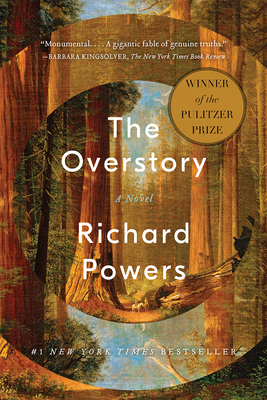
The Overstory by Richard Powers

Publisher: W. W. Norton & Company
Genre: Literary Fiction
Pages: 512
Format: Paperback
Buy Local
My Rating: 5/5
Summary

The Overstory is a vast novel with a dynamic cast of characters; at its core, it is the question of humanity’s compatibility with other forms of life. It is a novel that turns around the idea of man versus nature, where man is the protagonist and nature the antagonist, and makes it nature versus man, with nature as the protagonist and man as the antagonist. This is a story about trees, but it is not told from the perspective of trees, but rather those who have lived their lives alongside trees—and knowingly or not, formed a relationship with the objects that at some point they might have believed to be nearly inanimate. It explores complex crevices of our relationship to nature and shows that, like relationships between people, there is a give and a take. And also, just like relationships between people, imbalance in that give and take can be disastrous.

Thoughts

What was most striking to me about this novel was the way its form mirrors that of a tree. It starts with the seeds that would one day grow into the characters that it focuses on. Patiently, it nurtures those seeds until they pop up from beneath the soil and begin to intertwine around one another as they grow upward. As the characters form a trunk together, they continue to grow, and just as a trunk they begin to diverge from one another. Branches grow out in other directions, some fall off, but like a fallen tree in a forest, they cultivate a plethora of life, even after the life that they have known has transformed into something different. This carefully crafted novel feels groundbreaking in the way that it grows, and is breathtaking in the overall image that it is able to craft. 

On several levels this novel is epic in proportion—in its vast and dynamic cast of characters and in its actual length, but there is something else too. Reading it felt like a fantasy novel set in the modern world, particularly during the middle portion. There is a natural magic at play in this book, the whispering of trees, but also a sense of good and evil that goes beyond such a simple binary. This was another aspect of this novel that stood out as interesting to me. While I would certainly categorize it as a literary work, I think that it successfully borrows from tropes present in a lot of genre writing and manages to subvert and disguise them in a way that makes the story exciting while still feeling like a work of art.

I have always appreciated and admired trees while knowing relatively little about them. This novel changed that, not only because it is dripping with interesting facts about trees and the ecosystems they build, but because it made me curious to go out and learn more on my own. If you have ever felt even a slight connection to nature, this novel is likely to foster that connection and awaken something inside of you that you didn’t know was there. That is not to say that it stands on its stumps and pontificates about the preservation of the natural world though. Instead, it examines various relationships to trees and to nature from an empathetic viewpoint that reeled me in and kept me wanting more until the very last page.

I have nothing but praise for this novel, and I cannot recommend it enough. I think that it is a beautiful work of art that would enrich any reader’s life. With that said, I do have to make a note about how it took me over a month to finish it. When I said it was epic in proportion, I meant it. This was not an easy novel to consume, but it was well worth it.

Staff Book Spine Poetry

Since we were unable to meet in person for a social event this semester, our staff connected through a virtual book spine poetry reading, a great option that was both bookish and fun. Over video chat, each staff member shared a picture of their book stack, where they’d arranged book titles into a poem of their own. We found our results engaging and thought we would share them below!


Rachel, Editor-in-Chief

Wicked
headstrong,
big, little lies
FOOL
wise blood.

While creating this book spine poetry about the steadfastness of lies, I had to keep reminding myself to work with the titles I had on my bookshelf and to not get distracted by my wandering imagination. I needed to restrict my vocabulary to that of the authors in my library. In this challenging writing practice, I was reminded that limitations force us to be creative in new ways. What at first seems to be an unfortunate obstacle can actually help us to think differently and to create uniquely. As many of us find ourselves in uncertain and seemingly impossible situations during this new season, I think one hopeful silver lining is that this resilient, creative force we each have is able to thrive in moments of limitation. 


Payton, Managing Editor

Losers. 
Dispatches from the 
other side of the scoreboard;
Great expectations.
Girl, wash your face,
Eat, pray, love,
I'd give anything. 

My poem is about the struggle with perfectionism (very close to my heart) and the growth/pain of learning to accept weaknesses, picking yourself up, and not letting accomplishments or met/unmet expectations define your worth. 


Makenna, Communications Coordinator

This is What Happy Looks Like
This is what happy looks like:
a light in the attic,
love and gelato,
our family recipes.
Happier at home:
no one can take your place.

I dedicated this poem to my twin sister, who recently returned from eighteen months away from home on a service mission in another country. It represents our experience in two-week quarantine at home which was full of love and happiness through our reunion together as a family.


Roxanne, Staff Writer & Communications Coordinator Apprentice

Diary of an Oxygen Thief
A Dance with Dragons,
Imaginary Friend.
A Wrinkle in Time,
The Fault in our Stars.
Two by Two,
The Tenth of December.

The process behind this poem was a little chaotic. I essentially pulled out all of the books I have from my bookshelf at my college housing and stacked them in various ways, but it took a while to find a combination that I liked. Finally, I decided Diary of an Oxygen Thief was a great poem title, so I started there and moved down the line. I wanted to make sure it flowed like a poem, so I made sure some titles had determiners in them like “a” and “the” to add some separation. While it is still kind of list-like to me, I liked that it almost reads like thoughts or words someone (an oxygen thief?) jotted down quickly in a notebook. It adds an element of mysteriousness and that kind of became the mood of the poem in the end! 


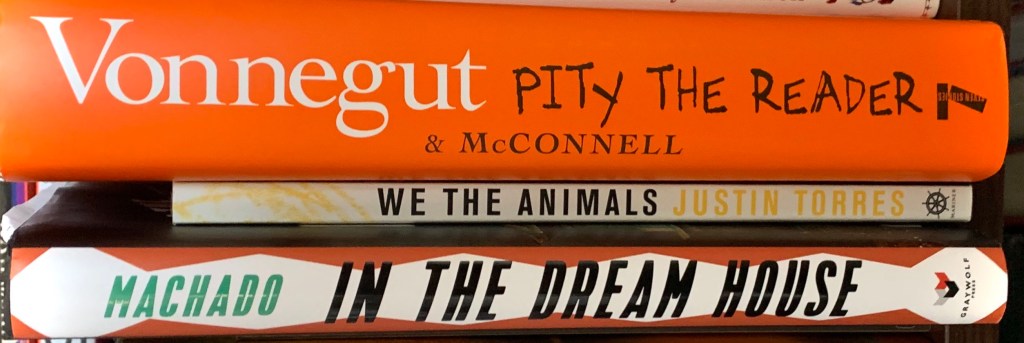
Edward, Staff Writer

Pity the Reader 
We the Animals
In the Dream House

I composed my poem specifically about the sound, wanting to put unique titles together.


Abhilasha, Staff Writer

Matters of the heart
Trouble the saints—
The cheapest nights,
Dead land.

When we’re emotionally involved, the lines between right and wrong get blurred. Matters of the heart need a margin of human error. Also, the most imperfect things can be beautified by a loving gaze—the cheapest nights, a stretch of barren land.


Jade, Staff Writer

How to Stop Worrying and Start Living:
Now that you're here, 
Don't be a stranger. 
Rise and shine, 
Chasers of the light: 
Start something that matters. 

When creating my book spine poem, my mind immediately went to the current state of the world and the fear and anxiety we are all undoubtedly feeling. My poem is meant to be a response to this and a reminder that the important things in our lives (connection, love, meaning) still exist amid the uncertainties. While worrying is an inevitable part of life, it’s important to remind ourselves that we can still choose to focus on the important things in life that bring us joy and a sense of meaning


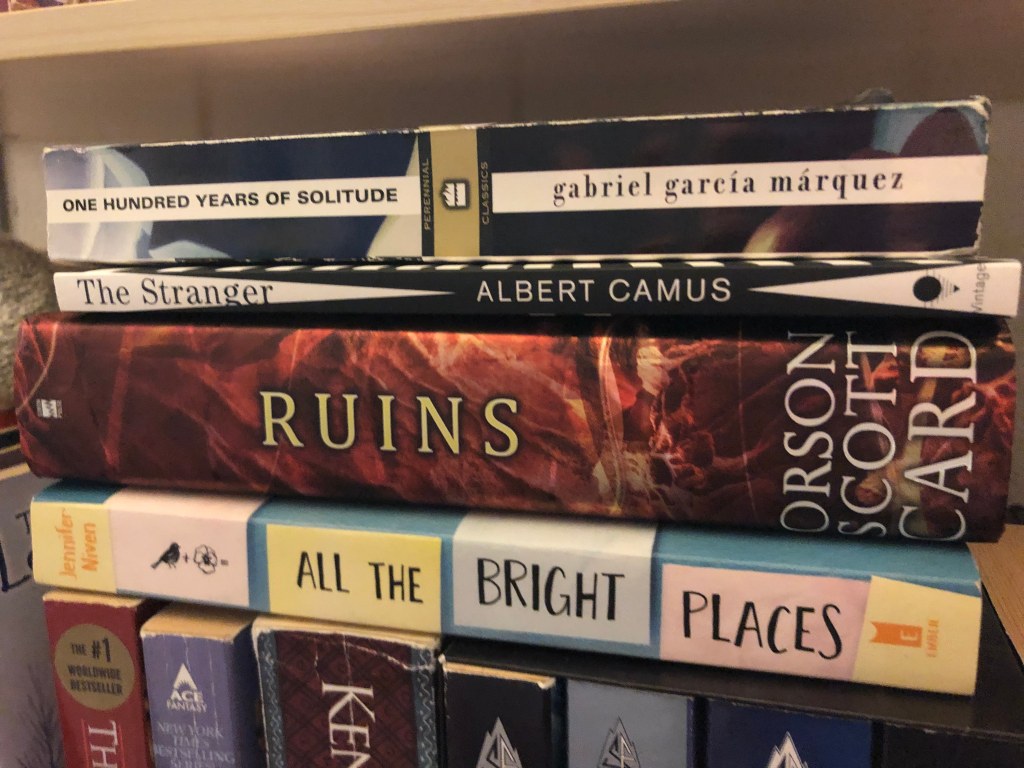
Mackenzie, Staff Writer

One Hundred Years of Solitude: 
The Stranger Ruins 
All the Bright Places

My process for creating this poem was to try to construct a narrative, so I looked for a book title that contained a verb and worked from there. I also tried to incorporate different genres of books I liked so that it represented what I like to read.


Erin, Staff Writer

Lost Souls
Waiting
On Earth we are briefly Gorgeous
Mumbo Jumbo

My book spine poem was created by grouping together titles that evoked similar feelings or images. Although I was working with a limited collection of my books, I enjoy how the poem turned out. My untitled poem is about the feelings of confusion and uncertainty that are plentiful in the world right now. For me, the poem acknowledges the beauty of being human in a largely chaotic world.


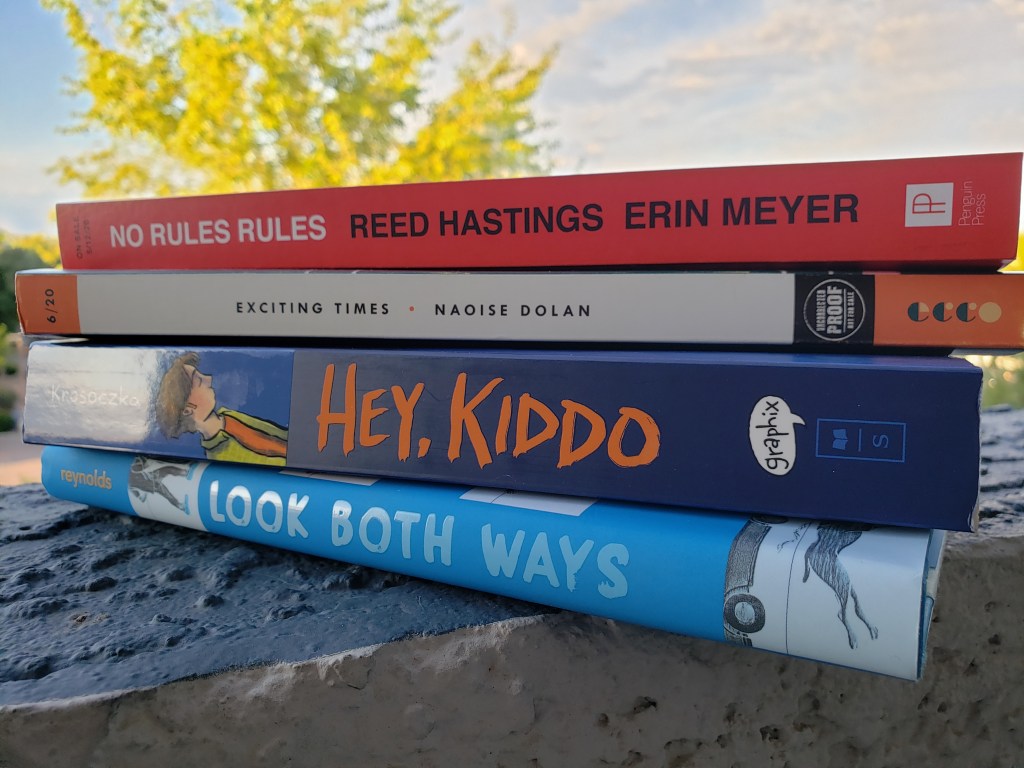
Sharon, Staff Writer

"no rules!"
RULES
exciting times
but
hey, kiddo
look
both
ways

As my daughter turns 18, her thoughts are consumed with the “no rules” lifestyle that she believes college will bring her. My poem is about my acknowledgement that these are indeed exciting times, but hey kiddo, you have to look both ways and not get tripped up by your own sense of freedom.


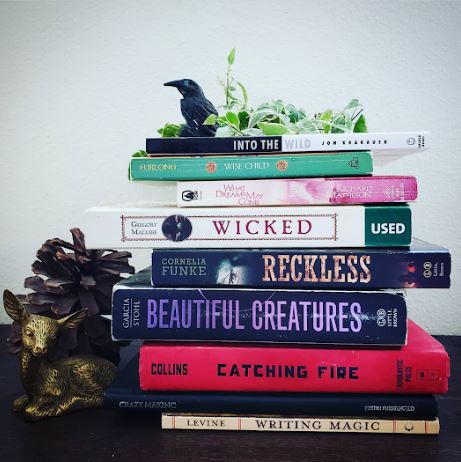
Amanda, Staff Writer

Into the wild, wise child
What dreams may come
With wicked, reckless 
Beautiful creatures
Catching fire
Crazy making
Writing magic

My inspiration came from Reckless and Beautiful Creatures being next to each other on my bookshelf. This poem is about being a writer, and how the writing process includes a little bit of chaos and darkness.


Bonus: Mackenzie, Staff Writer

History
A Dark History, The Tudors. 
The Source: 
Six Wives. 
—The Executioner's Journal.

I used my history books to construct a little joke about the craziness that is Tudor history. Enjoy!


Reading With Your Ears: The Pros and Cons of Audiobooks

This time of staying at home, sheltering in place, and social distancing is the perfect opportunity to catch up on your reading. Right now, readers are lucky to have so many options when to comes to getting their literary fix. With hardback, paperback, ebooks, and, of course—the main reason we are here—audiobooks, there is a format for every type of reader. 

I am not a seasoned pro when it comes to the audiobook format. Until recently I avoided them, not out of fear, but because I consider myself to be too tactile of a creature to be able to just listen to a book. I like the feel of the paper beneath my fingers, that quiet little shooshing noise as I turn the pages, and the satisfying weight of whatever novel in which I have lost myself. I was also concerned that I would get distracted and lose my place if I wasn’t visually focused.

Yet, as a reader, I didn’t feel that I would be complete without at least trying an audiobook on for size. So, for my first foray into the audiobook arena I chose a novel that I had read before—a bit of a safety net you could say. At the time of my experiment Doctor Sleep was in the theaters (remember when we could see movies on something other than Netflix?), and I figured Stephen King’s sequel to The Shining would be a good one to cut my teeth on (or perhaps I should say perk my ears up) in anticipation of the cinematic adaptation. Based on that experience, I ended up compiling a list of pros and cons on listening to your literature.


Pro #1 – Master of Multi-Tasking

Without a doubt the audio book format gives you a ton of freedom. Need to do some housework? Plug in, turn on, and off you go. Although, I don’t necessarily recommend listening while vacuuming since the two sounds compete. Have to run an errand? No worries, use your car’s bluetooth and be entertained on the ride. The majority of my listening was done in the car, and the only downside was getting to a juicy bit in the story and having to step out.


Con #1 – You’ve Lost That Touching Feeling

The audiobook experience isn’t a particularly tactile one. I suppose you could lovingly stroke your phone or computer or play with your headphone cord (if you have one) but it is just not the same. Flipping pages, and holding a good solid hardback has its own particular joy.


Pro #2 – Perfectly Portable

All of touchy feely stuff aside, it has to be said that hardbacks and paperbacks are not easy to transport. That lovely weight? It’s not as pleasant when you’ve added pounds to an already overloaded suitcase or backpack. The audio book is far more portable, and you can keep a list of titles at the ready. Dragging three or four books around just isn’t as convenient, or good for your back. 


Con #2 – The Voices in Your Head

Do you know that voice you hear every time the main character speaks in a novel? Me too! If you are listening to a book that you have read before the voice actor might not portray the character the way you imagined. It was a bit of a letdown to discover that Dan Torrance didn’t quite sound the way I expected. The narrator could be too animated, or not animated enough; they may be dull, or their pacing may not suit you. You never know exactly who are you getting when you hit play.


Pro #3 – Accessibility 

Like ebooks, audiobooks can be downloaded within seconds. No trip to the bookstore or library necessary! This feature is even more convenient considering the lockdown situation we are all in. The library offers a plethora of titles for the price of just having a library card, and now, local bookstores like Changing Hands offer them! You can check out their system for purchasing and downloading here.  A quick internet search will give you lots of additional options.


Con #3 – The Price Is Not Always Nice

There is a price for all that accessibility. An audiobook can cost you significantly more than a paperback or ebook. A quick search of bestselling audiobooks through various services revealed prices upwards of $24 with some reaching nearly $40. The same novel in an ebook, paperback, and even hardback format can cost you far less. However, if you are an avid listener, many sites offer a membership deal which makes far more financial sense.


Pro #4 – Storytime

Remember when your kindergarten teacher would gather you in a circle and read a story aloud? I view consuming a novel through the audiobook format to be a different kind of experience in reading—you’ve engaged a whole different sense.


Con #4 – Time Is Not On Your Side

Depending on your individual speed, you can actually spend more time listening to a book rather than reading one. You can adjust the speed in which you listen, so that can help, but I can tell you that it took me quite a bit longer to listen to Doctor Sleep than it did to read it.


So, would I do choose an audiobook again? Sure. It added some variety to my reading routine by giving me flexibility to read where and when I wanted. Would I trust an audiobook for a literature class? Never. Was Doctor Sleep some scary fun with Stephen King? Absolutely!

3 Books You Should Read before You’re Thirteen

Whether or not you’re a nostalgic person, you will never forget your favorite books growing up. Your taste in literature may change, along with your reading habits, but the books you read when you’re young are imprinted in your brain forever. Here are a couple books I read and re-read through middle school, along with one I wish I had read before my teenage years.


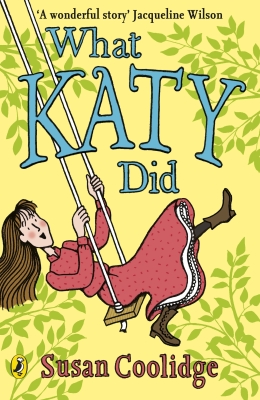
What Katy DidSarah Chauncey Woolsey. In college, Sarah Chauncey Woolsey wrote this charming novel under the pen name of Susan Coolidge. It follows Katy Carr, a twelve-year-old daydreamer, into adolescence. As the oldest of six children who lost their mother years ago, she is constantly expected to set an example to her younger siblings, which she often fails to do, but not for lack of enthusiasm. She is reminded of this frequently by her father, Dr. Carr, and Aunt Izzie, a strict disciplinarian who has been raising the children since their mother died. Aunt Izzie’s general disapproval of her only adds to Katy’s disappointment at being “all legs and elbows, and angles and joints.”

Among the many relationships that the book explores, a notable one is the strong bond between Katy and her sister Clover, second oldest of the Carr siblings. Shy, soft-spoken Clover complements Katy’s wild, whimsical nature. Katy doesn’t know exactly what she wants to do when she grows up, but she’s sure it will be something marvelous, and Clover faithfully agrees. Through the countless escapades, Katy grows on you with her wit and artlessness. It is a heartwarming story filled with colorful characters with interesting turns in the plot.


Black BeautyAnna Sewell. This famous autobiography of a horse personifies a handsome black stallion with a white star on his forehead. He begins at his dewy days as a foal on a farm. After he is broken in, he is bought by the village squire. Here he meets a few other horses, some of whom, he realizes, have not been as well-treated as he has. As he grows older, he moves from the countryside to the city, and has a diverse experience at the hands of several owners with varying temperaments. There are instances of animal cruelty in the book that give you the victim’s perspective on the subject.

The theme of empathy towards animals and their reciprocation to it is prominent throughout the book. When Black Beauty describes how uncomfortable it is to wear a bit, and how his first owner takes great care to make sure his breaking in is as comfortable as it can get, his affection for the farmer becomes prominent. Later, he grows to love his first ever groom, John. Black Beauty is the first popular novel to change the way we look at animal welfare, and is a classic for all ages.


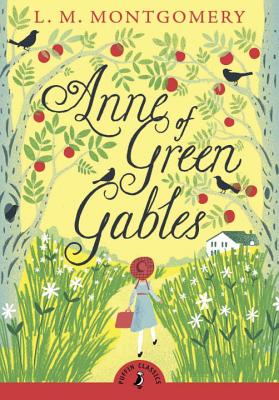
Anne of Green GablesL.M. Montgomery. The novel is set in the picturesque, fictional town of Avonlea where life is uneventful until the Cuthberts decide to adopt a boy from an orphanage to help around the farm. Matthew and his sister, Marilla Cuthbert, live in Green Gables, a house on the edge of the woods. When Matthew goes to receive the boy at the station, he is in for a surprise. A fortunate miscommunication brings Anne to Green Gables, which her extraordinarily imaginative mind transforms into something out of a fairy tale—something she frequently does with places and things. The only thing she can’t seem to improve with imagination is her red hair, which she hates.

Through many adventures and misadventures with her “bosom friend,” Diana Barry, and other assorted characters over the course of four years, Anne becomes irreplaceable in the hearts of her family and friends in Avonlea. Although Anne sounds mature for her age when she speaks, mostly because she uses long words, her naeïvete appears every now and then when she gets into scrapes, or when she tries to deal with the awkwardness of entering adolescence. Reading this book is a luxurious experience, full of eloquent descriptions of the most mundane things transformed into something exotic and beautiful through Anne’s eyes.