4 Books to Dive Into This Summer

Summer is just around the corner and, for me, there is nothing better than lying in a hammock with a good book. While it is arguable that most any book will work in this scenario, some books just scream “summer” more than others. After some thought, I have compiled a list of books that I think are perfect for diving into summer.


The Summer I Turned Pretty—Jenny Han. Starting off the list is a novel from the author of the To All the Boys I’ve Loved Before series. It follows the story of Belly, who looks forward to the summer all year. Each year, her family spends the season in the small town of Cousins where they join the Fishers, whose sons Jeremiah and Conrad have grown up with Belly. It’s a story of first love, heartbreak, and the summer sun. I used to read this book every year—it’s the perfect YA summer love story. If you’re looking to get into the summer mood, then I highly recommend giving this novel a chance. If you like it, it’s part of a three book series!


Red White & Royal Blue—Casey McQuiston. It wouldn’t be a summer reads list without this fan favorite. This novel tells the story of Alex Claremont-Diaz, whose mom is the President of the United States. When the tabloids get a hold of a physical altercation between him and the Prince of Wales, a variety of problems arise. In the efforts between the two countries to mend the relationship comes a heart-warming and unlikely love story. There’s a reason this novel is so popular, and as summer rolls around I find myself gravitating towards it again.


It Had to Be You—Georgia Clark. This is a newer release—it came out about two weeks ago—but I have a feeling it is going to be the novel of the summer. Told in a style similar to Love Actually, this novel tells the story of Liv Goldenhorn, who is not only dealing with the death of her husband, but also the fact that he left half of their business to his mistress, Savannah. For obvious reasons, Liv isn’t happy about this, and when Savannah comes to work with her, they don’t exactly mesh right away. However, long nights and deep conversations have a way of revealing hidden depths about people, and both Savannah and Liv find that not everything is what meets the eye. It’s a witty, heartwarming story that perfectly captures that summer feeling.


The Girl from Widow Hills—Megan Miranda. I read this novel at the beginning of last summer and as I was thinking of novels for this post that were less romance-y but still summer-y, and this one immediately popped into my head. This novel follows Arden Maynor, who now goes by Olivia Meyer, 20 years after she was found in a storm drain in the small town of Widow Hills. She has spent her life trying to distance herself from her past, but it always has a way of catching up. This novel is shocking and thrilling while still maintaining that summer feeling. If summer romances aren’t as much your thing, I highly recommend checking this novel out.
Literary Event: First Draft Book Club| Patricia Engel’s “Infinite Country”

Join the First Draft Book Club as they virtually welcome USA Today Books Editor, Barbara VanDenburgh to discuss May’s Changing Hands staff pick.

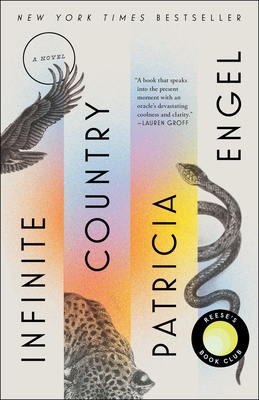
Infinite Country by Patricia Engel is a New York Times bestseller that follows Talia, a young girl being held in a Colombian correctional facility.

Against a ticking clock, Talia must devise a plan to meet up with her father, where their departure to the United States will bring renewed hope and safety for their family. Weaving Talia’s current story with the events of her parents Mauro and Elena’s lives, Infinite Country brings together various timelines against a backdrop of civil unrest and the reality of undocumented life.

Register for the First Draft Book Club here.


Location: Online

Date: Saturday, May 29th, 2021

Time: 7:00 – 8:30 p.m.

Price of Ticket: FREE

Book Review

Staff Writer Book Club

Publisher: Ember
Genre: YA Fiction, Psychological Thriller
Pages: 320
Format:
Paperback
Buy Local
Staff Rating: 4.5/5

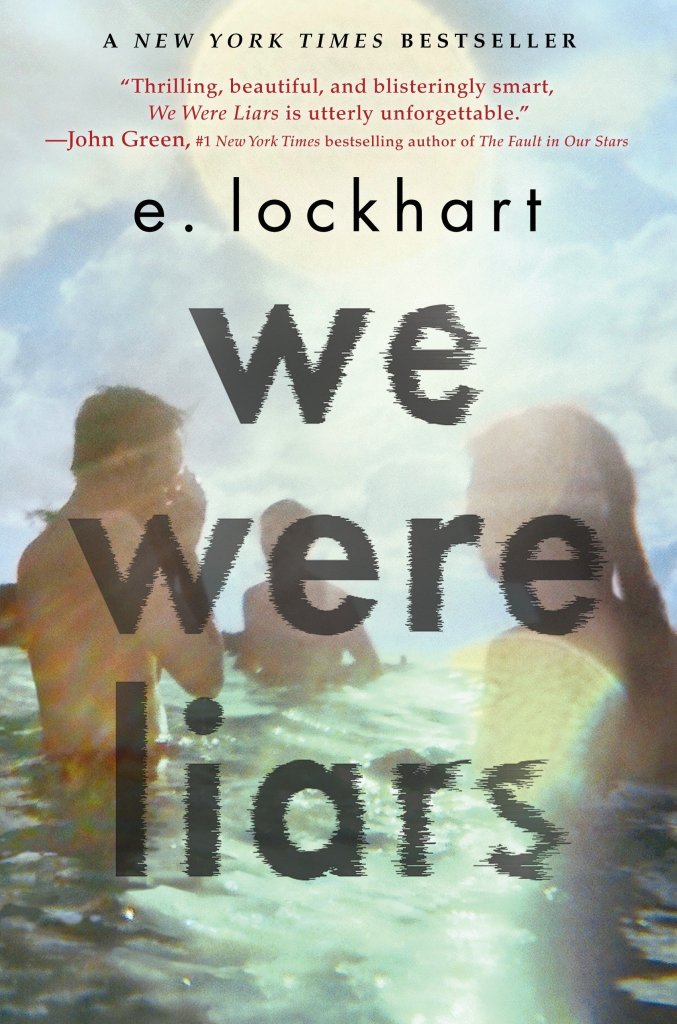
This semester, we opted for safety and continued to hold our social event over Zoom. Last month, we all read E. Lockhart’s novel We Were Liars and then got together to share our reactions! We discussed the novel at length and wanted to share our thoughts with you.

Summary

Despite being published seven years ago, We Were Liars has been sweeping the internet these last few months. From the point of view of the protagonist, Cadence Sinclair Eastman, we are whisked into her world of summers on her grandfather’s private island. There, she joins her cousins, Johnny and Mirren, and family friend, Gat for the perfect summer. But with the aunts fighting and kids being stuck in the middle, it is anything but the idyllic summer they were hoping for. Without giving too much away, we can tell you that everything is not as it seems on this island in paradise.

Thoughts

This novel was full of surprises and we couldn’t wait to go through all of them. While, for some of us, it wasn’t the first time reading it, we all found ourselves shocked at the turn of events. Those of us who had read it before pieced together the clues until our memory was jogged, and for those of us who didn’t know what was coming, it was mind-blowing. Our Staff Writer, Lauren said that while she was reading it for the second time, she “really appreciated how much the narration influenced the story and how events are revealed.” Personally, I hadn’t read the novel before and it was one of those moments where you have to stop reading and close the book because you can’t believe it.


Aside from the gripping storyline, the way Lockhart describes people and scenes is mesmerizing—her word choice truly carries you through the novel. We discussed some of her attention to detail in depth and something we pinpointed was that she very thinly walks the line of literal and metaphorical, so much so that there are spaces where the events feel real but with further context turn out to be metaphorical. Our Managing Editor, Jade, explained that she “loves the way that Lockhart explains the characters with the same symbols every time and how the repetition plays so heavily into the plot.” Lockhart truly has a way with words which couples beautifully with unfolding of the plot.


It’s hard to say specifics without giving away the plot, but know that you’re in for a treat if you pick this novel up.

Staff Book Spine Poetry

Be brief, be buoyant, and be brilliant.

– Brander Matthews, American Poet

What started out as an antidote for not being able to gather for a social event in 2020, has now become a tradition in 2021! Spine poetry (compiling a piece of poetry through stacking books) is a great way to flex your creative muscles, and perhaps even discover some forgotten favorites. Taking inspiration from our own bookshelves, some of our staff writers have created some beautiful and inspiring works of visual and literary art. Enjoy!


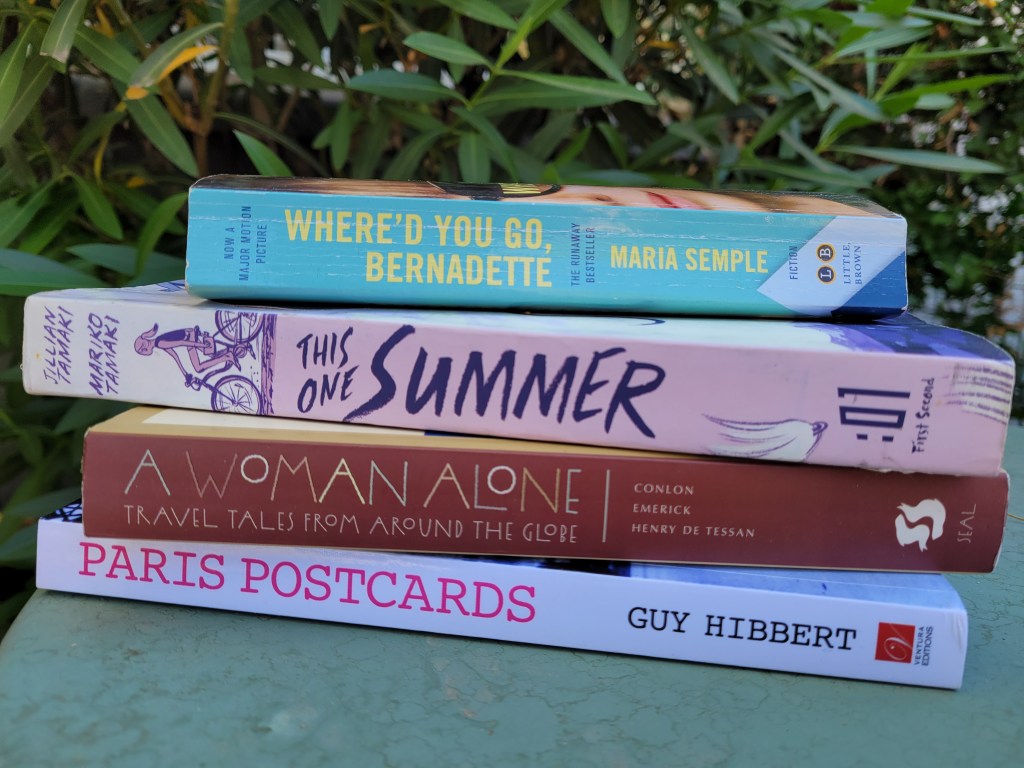
Sharon, Editor-in-Chief

Where'd you go, Sharon
this one summer
a woman alone
Paris postcards

Ever since I have had to hunker down at home, I have been dreaming of the day that I can take off on an adventure. I looked for travel inspiration on my bookshelf and found quite a few titles that would work (apparently wanderlust is part of my genetic makeup). These titles in particular I found to be engaging, and got me daydreaming about a summer all alone in Paris, writing postcards back home as I people watch from the park, or a cafe. Here’s to all the wanderers out there—may we have the opportunity to adventure soon!


Jade, Managing Editor

A Brief History of Time:
Wild embers, a thousand splendid suns,
turtles all the way down.
Outliers, chasers of the light:
Decoding the world.

This book spine poem was largely influenced by the first book in the list, Stephen Hawking’s A Brief History of Time. The rest of the poem became a bit of an ode to science and discovery, as well as some of the elusive mysteries of the universe. It’s also a love letter to scientists and discoverers, the eccentric thinkers whom we have to thank for so many of today’s inventions and theories.


Roxanne, Communications Coordinator

The Fault in Our Stars,
Envy
The Innocent -
We were liars,
dangerous girls
in all the bright places 

My inspiration behind this book spine poem came from staring at my bookshelf looking for inspiration. I stumbled on The Fault in our Stars and decided to look for books that could be descriptions of what those faults are that could then end with All the Bright Places. This resulted in me frantically grabbing the rest of these books and stacking them in various ways until I decided this order fit really well. I really like the variety in the book genre and am happy with how it turned out!


Paul, Staff Writer

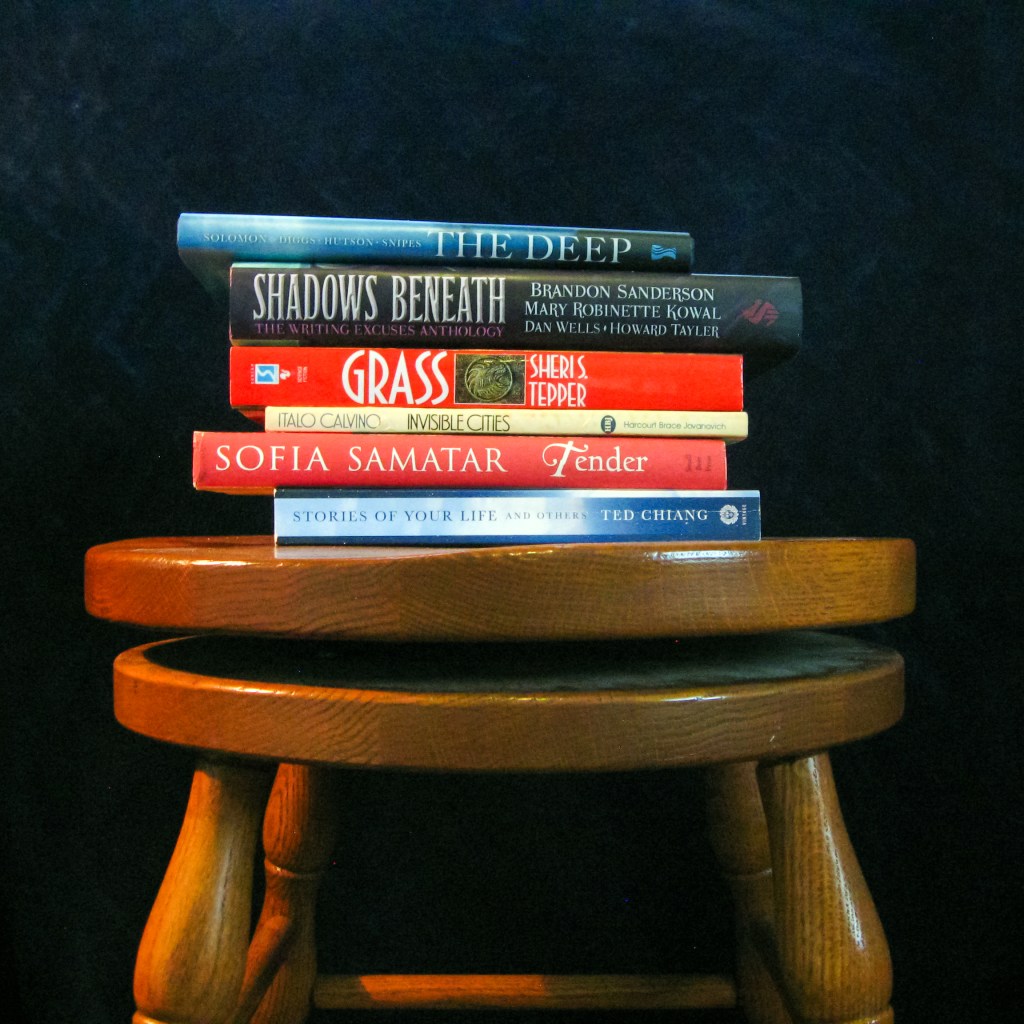
The deep shadows beneath grass:
Invisible cities,
Tender stories of your life and others.

This is a poem about ants. My favorite author, Ursula K. Le Guin, once wrote a science fiction story about future linguists who learn to translate the literature of animals. It is titled “The Author of the Acacia Seeds. And Other Extracts from the Journal of the Association of Therolinguistics,” and contains poetry written by an anarchist ant (quite a rarity in ant society).

Another of my favorite writers, Ada Palmer, wrote of ants in her book Seven Surrenders: “Humanity is forever boasting of its ‘unique’ achievements: humans are the only creatures who build cities, use agriculture, domesticate animals, have nations and alliances, practice slavery, make war, make peace; these wonders make us stand alone above all other creatures, in glory and in crime [. . .] Except ants.”


Rikki, Staff Writer

Living A Feminist Life,
this is an uprising,
emotional intelligence,
ethical slut,
period power!
When We Fight We Win.

I created this book spine poem from a feminist orientation using books from multiple genres. Taking inspiration from Ahmed’s book Living a Feminist Life —as well as using it as a first line in the book spine poem—I wanted to highlight some of what radical and intersectional feminism creates or privileges as possibilities and strengths of the movement. What’s political is also personal and what’s personal is also political, including our emotional states, our sexual expression, and our acts of/for social change: “when we fight, we win!” 


Hopefully, our art has inspired you to create your own!

A Childhood in Books and the Importance of Local Libraries

“A library is a place that is a repository of information and gives every citizen equal access to it. That includes health information. And mental health information. It’s a community space. It’s a place of safety, a haven from the world. It’s a place with librarians in it.”

– Neil Gaiman, “Why our future depends on libraries, reading and daydreaming

Opening Pages

My first memories of reading come from when I was about four or so. My dad sat me on his lap and pulled out an illustrated edition of The Hobbit. I can still picture the wonder on the faces of the elves as little Bilbo (about the same size as I was) held up the Arkenstone for them to behold. When we’d finished I asked to start again.

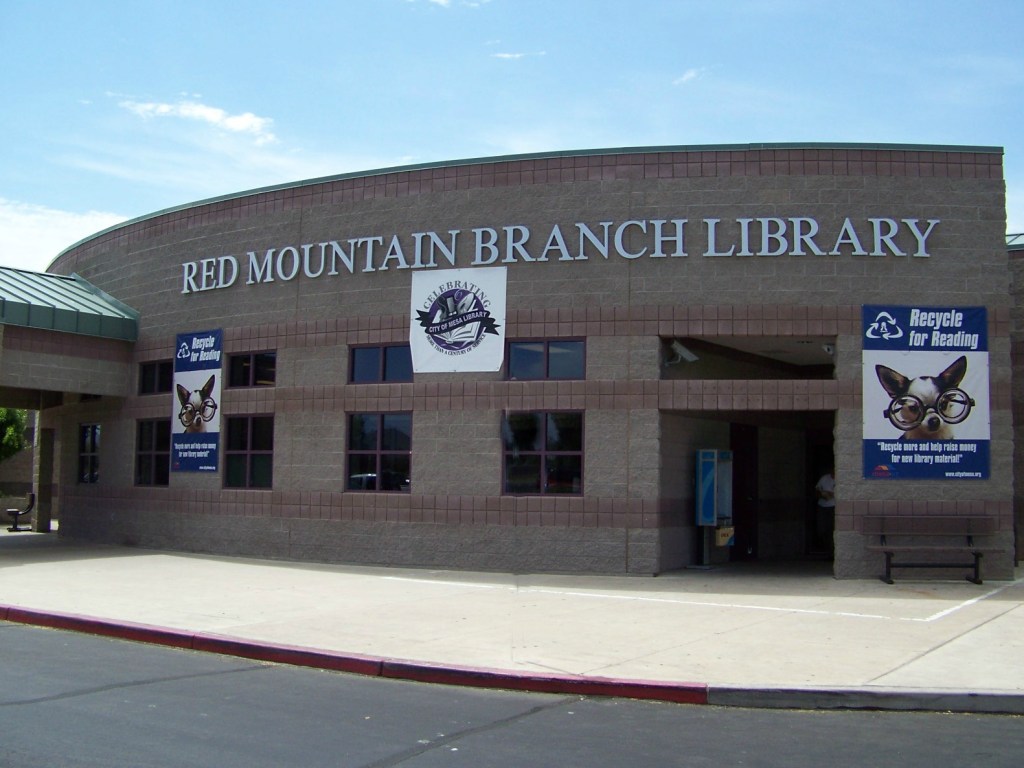
But my first memories of reading by myself come from the library. We moved within biking distance of Red Mountain Branch Library shortly before my eighth birthday.

I remember walking into the building, the sweat from cycling up the long climb of Adobe Street in the summer sun cooling in the blast of the air conditioning. And just inside and off to the left of the entrance was a big archway of yellow, orange, and green blocks. The neon sign above it read “Children’s Library.” I took the sign literally: this was the part of the library that belonged to me.

The children’s library had its own desk and its own librarian. This meant I didn’t have to stand in line with a bunch of adults to ask my questions. And boy did I have a lot of questions.

They let me sign up for my own library card, highlighter yellow with my name scrawled across the back in illegible chicken scratch. The limit was 35 books at the time (a limit I knew because I regularly hit it). I checked out every book in the Redwall series by Brian Jacques, went home with a bulging backpack, and by the time they were due I was ready for a new series.

Middle Chapters

By the time I was thirteen, I was far too cool to be seen near the children’s section. I was a teenager, which to me meant getting a stool and grabbing something from the top shelves (though I’d often sneak back to children’s section when no one was watching to nab the latest installation in Brandon Mull’s Fablehaven series).

In 2013, Red Mountain Branch opened a new wing called THINKspot: a place full of sewing machines and 3D-printers and cameras and computers. Most important to me, it had a conference room anyone could sign out for a couple hours if they wanted to hold a meeting. This allowed me—a self-conscious teen who hated having people at his house—to host a writing group. I’m sure we were annoying, a bunch of loud fifteen year-olds who spent half the time watching YouTube videos on the conference room monitor. But no one ever told us we couldn’t be there.

That’s what meant the most to me about Red Mountain Branch. It was a place I could go without getting kicked out for being a kid or not having any money. Mesa has always suffered from a paucity of community-oriented spaces, which made the library that much more valuable. It was unique. It taught me what a community space could and should look like.

The Ending or New Beginnings

In 2019 it had been a couple of years since I’d last been to the library. But as fortune would have it, I moved back to Mesa and found myself living once again within biking distance of Red Mountain Branch.

In my absence, they’d opened a miniature bookstore where they sold off old books that were going out of circulation. Thumbing through the stacks, I found the exact (somewhat beat-up) copy of the first collection of Ray Bradbury stories I’d ever read. It cost two dollars. Holding it, I felt like my life had closed a circle.

On that same visit, I got a new library card. As I signed the back, I realized that when I got my last library card was the first time I ever signed my name.

Epilogue

On March 16, 2020, Red Mountain Branch temporarily closed its doors due to Covid-19. They would remain so for an entire year. During that year, librarians staffed the CARES call center—a City of Mesa initiative to inform residents how to petition the city government for funding for their small businesses, rent, or utilities if their ability to pay had been impacted by the pandemic.

As of April 2021, the branch has reopened for business. They had planned to debut a new monarch garden and reading sanctuary last year, but had been delayed (for obvious reasons). This sanctuary is now open, just in time for the Arizona’s monarch breeding season (March – June).

I encourage any readers who live in Mesa to go show the library your support as it reopens. A list of library events and updates can be found here. If you don’t feel comfortable going in-person, you can get books from the library online at phoenix.overdrive.com.

The author would like to express thanks to Joyce Abbott, the manager of Red Mountain Branch Library, for answering his questions regarding the library’s history and programming.

Amazon vs Local Bookstores

This past winter I visited my friend and while walking in the downtown area we approached a local bookstore. Upon grazing the shelves for about an hour I stumbled on a small roughly twenty page pamphlet titled How to Resist Amazon and Why by Danny Caine.

What I was presented with was a whole world of which I was previously unaware. While I am sure most people have some awareness of Amazon’s tragic effect on local businesses, consumers, and employees, I found Caine’s pamphlet to be an invaluable resource related to their impact on my personal favorite retail outlet—bookstores. However, this pamphlet isn’t the only resource highlighting the difficult relationship between Amazon and local bookstores. The fact that Amazon is harmful to local booksellers has been well documented by a plethora of news sources, including a New York Times article detailing how counterfeit books are often sold and promoted involuntarily on Amazon (Streitfeld, 2019), and an article in Forbes describing the new company Boohshop.org that provides local affiliate bookstores a 10% commission compared to 4.5% commission (Verdon, 2020).

Most people, myself included, are attracted to Amazon for their low prices, fast delivery, and availability of a wide selection of books. However, I never thought about why these books are so cheap. As Danny Cain articulates in his pamphlet, bookstores receive a particular discount when ordering from a publisher and if they sell these books for roughly the same amount they purchased them, they wouldn’t be making enough to sustain their business (Caine, 2019). Your local bookstore can’t afford to sell books at a loss, but Amazon—a very wealthy company—can afford to sell books for the amount they purchased or below because they can afford to lose money on this product (Caine, 2019). It isn’t necessarily a matter of Amazon being the evil villian—it is more that these bookstores simply can’t compete because their business reality is much different than that of Amazon’s. Bookstores are a local business that provide much more than just a book to the hands of consumers: these stores offer an environment, a community, and promote local artists and authors. However, because Amazon is the behemoth that it is, many of these beloved local shops are suffering. Hence the dire need to promote and sustain such a vital aspect of so many communities and the literary world.

But what if you really don’t care about the bookstore and just the book? Farhad Manjoo (2011) of Slate actually advocates for Amazon’s prominence as a bookseller stating that “no company in recent years has done more than Amazon to ignite a national passion for buying, reading, and even writing new books” (Manjoo, 2011). Manjoo (2011) then proceeds to critique the consumer experience at local bookstores, essentially considering that Amazon is the best means to purchase your books. However, even if you don’t care about any of these community benefits, perhaps consider that shopping local—whether at a farmers market or a bookstore—prevents economic leakage and promotes local self reliance within your community. Economic leakage, according to Roseland (2012), “occurs when community members travel outside the community to spend their locally generated income on non-local purchases, or when residents make purchases within the community on products that were originally purchased or manufactured elsewhere” (p.218). This money moves outside the local economy and doesn’t promote economic development within the community (Roseland, 2012). In working with local bookstores, or local shops in general, individuals promote local self-reliance—which is about creating a more sustainable community focused on local needs, cohesiveness, and a reduction of waste and beneficial trade practices (Roseland, 2012, p. 217). In order to bolster this foundation of economic development individuals must “where possible, invest in the local economy by substituting locally made products” (p.217). This promotion of the local economy includes bookstores.
I know this isn’t your typical light-hearted post about charismatic books and authors we all love but I, and The Spellbinding Shelf, wanted to bring attention to those booksellers who are the backbone of not just our community, but our favorite authors and novels. If you are interested in learning more about how and why to resist Amazon, or even about supporting local bookstores, I suggest Danny Caine’s How to Resist Amazon and Why. Bonus—it is also available at Changing Hands (our favorite local bookstore)!

Caine, D. (2019). How to resist Amazon and why (2nd ed.). Microcosm Publishing.

Forbes. https://www.forbes.com/sites/joanverdon/2020/02/14/advocate-for-local-

bookstores-takes-aim-against-amazon-with-new-website/?sh=471363043407

Manjoo, F. (2011, December 13). Don’t support your local bookseller. Slate.

https://slate.com/technology/2011/12/independent-bookstores-vs-amazon-buying

-books-online-is-better-for-authors-better-for-the-economy-and-better-for-you.html

Roseland, M. (2012). Community Economic Development. In, Toward Sustainable 

Communities: Solutions for citizens and their governments (pp. 209-228). New Society 

Publishers.

Streitfeld, D. (2019, June 23). What happens after Amazon’s domination is complete? Its 

bookstore offers clues. New York Times. https://www.nytimes.com/

2019/06/23/technology/amazon-domination-bookstore-books.html

Verdon, J. (2020, February 14). Local bookstores have a new weapon in the fight with Amazon.